The over-inoculation phenomenon

Introduction
In the first two contributions of this series, “Critical issues in inoculation practice and main inoculants” and “How much do you understand about your in-stream inoculation effect?”, it was highlighted how inoculation represents one of the most sensitive metallurgical stages of the melting process and, in particular, how in-stream inoculation cannot be considered an inherently reliable operation in the absence of dedicated control systems. The critical issues related to molten iron flow variability, misalignment between metal and inoculant, and the metallurgical and economic consequences of unmonitored post-inoculation were analysed.
This third paper focuses on a less intuitive, yet extremely insidious consequence of uncontrolled inoculation management: over-inoculation. Through a real case study, the paper examines a situation in which a foundry experienced increasing problem of shrinkage porosity and microporosity without being able to identify an evident cause, despite chemical parameters and conventional analyses indicating an apparently controlled condition.
The case demonstrates how, in the absence of advanced thermal analysis and inoculation control systems, over-inoculation can develop gradually and “invisibly”, often because of incorrect corrective strategies adopted to compensate for other process instabilities. The progressive accumulation of inoculants, also favoured by a high percentage of cast iron returns in the charge, can significantly alter the solidification behaviour of the metal, leading to early graphite precipitation and, consequently, the formation of porosity.
The aim of this paper is to analyse the case study in a concise but rigorous manner, identifying the metallurgical and operational causes of over-inoculation and illustrating the corrective actions implemented to restore process control. In particular, it will be shown how the introduction of advanced thermal analysis systems (ITACAX™) and in-stream inoculation control solutions (ITACA Stream™ and ITACA Vision™) was instrumental in understanding the issue, eliminating its root causes, and drastically reducing defect levels, without requiring geometric modifications to the castings or the feeding system.
How did the critical issue develop?
This study analyses the case of a ductile iron foundry with a production process considered stable and well established. The plant consisted of:
- medium-frequency induction furnaces;
- ladle spheroidization treatment, sandwich method;
- automatic vertical moulding lines.
Metallurgical process control was based exclusively on:
- chemical composition;
- molten metal temperature;
- absence of direct control over solidification behaviour.
In an initial stage, localized defects related to cementite and carbides appeared, concentrated in critical areas of the castings. The foundry responded by increasing the total inoculation level, distributing it across different stages of the process:
- preconditioning;
- pre-inoculation;
- late inoculation.
This intervention led to the disappearance of carbides, confirming the high sensitivity of the process to nucleation potential. However, in the medium term, shrinkage microporosity defects began to appear, also localized and initially limited to specific areas of the casting.
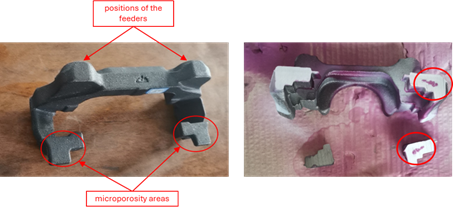
Figure 1: image of the casting from the case study, with the positions of the risers and microporosity highlighted
The interpretation of this phenomenon as a further metallurgical deficiency led the foundry to increase the inoculation level even more. This decision proved ineffective and counterproductive:
- microporosity did not decrease;
- the defect progressively spread to an increasing number of castings.
Despite remaining within chemical specification limits and with apparently stable operating conditions, the process was therefore evolving toward a condition of over-inoculation. This condition, not detected by conventional control systems, proved to be the actual cause of the initiation and propagation of microporosity.
When returns become the real issue
Up to this stage, the situation could still be considered critical but potentially manageable through targeted optimization of inoculation. The process balance was definitively compromised when the foundry decided to modify the feeding system by increasing risers volume in an attempt to compensate for shrinkage microporosity.
This decision proved inappropriate, as the original feeding system had been correctly designed. Shrinkage porosity was not an inherent process defect, but rather an indirect consequence of altered metallurgical conditions of the iron. The enlargement of risers therefore produced significant side effects:
- reduction in pattern yield;
- increase in the amount of returns generated.
This configuration triggered a self-reinforcing mechanism. On one hand, the presence of porosity increased scrap rates; on the other, the increased riser volume further raised the amount of available returns. The overall result was a progressive increase in the percentage of remelted iron in the charge mix.

Figure 2: original melting process conditions
This aspect is particularly critical because returns introduce a residual fraction of inoculants into the process, associated with metallurgical heredity. As a result:
- each remelting cycle reintroduces “invisible” inoculants into the melt;
- these contributions cannot be detected through chemical analysis alone;
- the overall level of inoculation increases in an uncontrolled manner.
In this scenario, the apparent stability of the process masked a progressive drift toward over-inoculation, driven not only by intentional additions but primarily by the systematic re-melting of returns. This dynamic, difficult to identify without advanced thermal and process control tools, makes the management of returns one of the most critical aspects of the entire case study.
Restoring metallurgical control: approach and solutions adopted
In the described scenario, identifying the true root causes was particularly complex, as the observed anomalies were not directly attributable to individual process variables and control was limited to conventional parameters. For this reason, Proservice metallurgists intervened using a systemic approach, analysing the entire melting process through the advanced thermal analysis software ITACAX™.
The analysis revealed a highly unstable process from a solidification standpoint, characterized by significant variability already at the level of base iron produced in the melting furnaces. This variability was further amplified in the final stages of the process, where high inoculation levels enhanced the non-repeatable solidification behaviour, masking a condition of progressive over-inoculation.
Based on these findings, the corrective strategy was built around a key concept: reconstructing a metallurgical “zero point”. To achieve this, a complete revision of the charge mix was carried out, focusing on two fundamental aspects:
- drastic reduction of the percentage of cast iron returns;
- introduction of a significant share of pig iron in order to limit the effect of inoculant heredity.
At the same time, the process was progressively brought back under control through systematic use of ITACAX™, which allowed a substantial reduction in the metallurgical variability of the base iron, both in terms of solidification dynamics and nucleation potential. On this basis, the inoculation process was completely recalibrated, significantly reducing inoculant additions and, in some stages, eliminating them altogether to avoid redundant and inefficient additions.
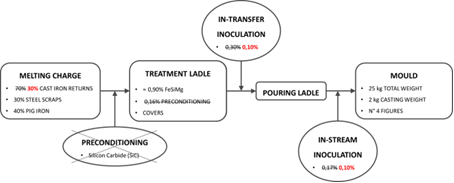
Figure 3: melting process conditions after process optimization
Concurrently, the combined ITACA Stream™ and ITACA Vision™ system was installed on the pouring lines, with the objective of achieving full and repeatable control of in-stream inoculation. This made it possible to drastically reduce final inoculation while ensuring that the inoculant effectively interacted with the molten iron stream in a controlled and consistent manner.
The effectiveness of the intervention was immediate and clearly measurable:
- drastic reduction in shrinkage microporosity;
- no reappearance of cementite-related defects;
- restoration of metallurgical process stability.
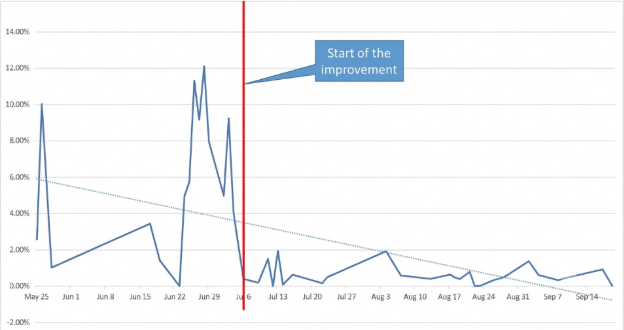
Figure 4: trend of scrap rate before and after melting process optimization
The recovery of metallurgical control also enabled a redesign of the feeding system, reducing riser volumes and consequently limiting the remelting of returns. This definitively interrupted the self-reinforcing mechanism that had generated and sustained the problem.
Conclusions
The presented case study demonstrates how over-inoculation can develop gradually and remain difficult to detect in a process that, based on traditional controls, initially appears stable. In the absence of advanced thermal analysis and inoculation monitoring systems, the issue is often addressed by further increasing inoculant additions, triggering a self-reinforcing mechanism that leads to increasing metallurgical instability and the onset of shrinkage microporosity.
The analysis highlighted the critical role of return re-melting, which reintroduces “invisible” inoculants into the melt through metallurgical heredity. This condition cannot be detected by chemical analysis alone but becomes evident through variability in solidification curves and thermal parameters.
The corrective strategy adopted, based on reducing return material in the charge, recalibrating inoculation levels, and introducing systematic control through ITACAX™, integrated with ITACA Stream™ and ITACA Vision™ for in-stream inoculation management, made it possible to restore metallurgical process control. The results were immediate: drastic reduction in shrinkage porosity, elimination of cementite defects, stabilization of solidification, and recovery of production yield.
In continuity with the previous two papers, this third contribution confirms that inoculation cannot be managed as a static parameter, nor corrected by indiscriminately increasing additions. Only a quantitative and integrated control of the process, based on thermal analysis and real-time monitoring of inoculation, allows the prevention of under- or over-inoculation and ensures stable, repeatable, and high-quality production.
Introduction
In the first two contributions of this series, “Critical issues in inoculation practice and main inoculants” and “How much do you understand about your in-stream inoculation effect?”, it was highlighted how inoculation represents one of the most sensitive metallurgical stages of the melting process and, in particular, how in-stream inoculation cannot be considered an inherently reliable operation in the absence of dedicated control systems. The critical issues related to molten iron flow variability, misalignment between metal and inoculant, and the metallurgical and economic consequences of unmonitored post-inoculation were analysed.
This third paper focuses on a less intuitive, yet extremely insidious consequence of uncontrolled inoculation management: over-inoculation. Through a real case study, the paper examines a situation in which a foundry experienced increasing problem of shrinkage porosity and microporosity without being able to identify an evident cause, despite chemical parameters and conventional analyses indicating an apparently controlled condition.
The case demonstrates how, in the absence of advanced thermal analysis and inoculation control systems, over-inoculation can develop gradually and “invisibly”, often because of incorrect corrective strategies adopted to compensate for other process instabilities. The progressive accumulation of inoculants, also favoured by a high percentage of cast iron returns in the charge, can significantly alter the solidification behaviour of the metal, leading to early graphite precipitation and, consequently, the formation of porosity.
The aim of this paper is to analyse the case study in a concise but rigorous manner, identifying the metallurgical and operational causes of over-inoculation and illustrating the corrective actions implemented to restore process control. In particular, it will be shown how the introduction of advanced thermal analysis systems (ITACAX™) and in-stream inoculation control solutions (ITACA Stream™ and ITACA Vision™) was instrumental in understanding the issue, eliminating its root causes, and drastically reducing defect levels, without requiring geometric modifications to the castings or the feeding system.
How did the critical issue develop?
This study analyses the case of a ductile iron foundry with a production process considered stable and well established. The plant consisted of:
- medium-frequency induction furnaces;
- ladle spheroidization treatment, sandwich method;
- automatic vertical moulding lines.
Metallurgical process control was based exclusively on:
- chemical composition;
- molten metal temperature;
- absence of direct control over solidification behaviour.
In an initial stage, localized defects related to cementite and carbides appeared, concentrated in critical areas of the castings. The foundry responded by increasing the total inoculation level, distributing it across different stages of the process:
- preconditioning;
- pre-inoculation;
- late inoculation.
This intervention led to the disappearance of carbides, confirming the high sensitivity of the process to nucleation potential. However, in the medium term, shrinkage microporosity defects began to appear, also localized and initially limited to specific areas of the casting.
Figure 1: image of the casting from the case study, with the positions of the risers and microporosity highlighted
The interpretation of this phenomenon as a further metallurgical deficiency led the foundry to increase the inoculation level even more. This decision proved ineffective and counterproductive:
- microporosity did not decrease;
- the defect progressively spread to an increasing number of castings.
Despite remaining within chemical specification limits and with apparently stable operating conditions, the process was therefore evolving toward a condition of over-inoculation. This condition, not detected by conventional control systems, proved to be the actual cause of the initiation and propagation of microporosity.
When returns become the real issue
Up to this stage, the situation could still be considered critical but potentially manageable through targeted optimization of inoculation. The process balance was definitively compromised when the foundry decided to modify the feeding system by increasing risers volume in an attempt to compensate for shrinkage microporosity.
This decision proved inappropriate, as the original feeding system had been correctly designed. Shrinkage porosity was not an inherent process defect, but rather an indirect consequence of altered metallurgical conditions of the iron. The enlargement of risers therefore produced significant side effects:
- reduction in pattern yield;
- increase in the amount of returns generated.
This configuration triggered a self-reinforcing mechanism. On one hand, the presence of porosity increased scrap rates; on the other, the increased riser volume further raised the amount of available returns. The overall result was a progressive increase in the percentage of remelted iron in the charge mix.
Figure 2: original melting process conditions
This aspect is particularly critical because returns introduce a residual fraction of inoculants into the process, associated with metallurgical heredity. As a result:
- each remelting cycle reintroduces “invisible” inoculants into the melt;
- these contributions cannot be detected through chemical analysis alone;
- the overall level of inoculation increases in an uncontrolled manner.
In this scenario, the apparent stability of the process masked a progressive drift toward over-inoculation, driven not only by intentional additions but primarily by the systematic re-melting of returns. This dynamic, difficult to identify without advanced thermal and process control tools, makes the management of returns one of the most critical aspects of the entire case study.
Restoring metallurgical control: approach and solutions adopted
In the described scenario, identifying the true root causes was particularly complex, as the observed anomalies were not directly attributable to individual process variables and control was limited to conventional parameters. For this reason, Proservice metallurgists intervened using a systemic approach, analysing the entire melting process through the advanced thermal analysis software ITACAX™.
The analysis revealed a highly unstable process from a solidification standpoint, characterized by significant variability already at the level of base iron produced in the melting furnaces. This variability was further amplified in the final stages of the process, where high inoculation levels enhanced the non-repeatable solidification behaviour, masking a condition of progressive over-inoculation.
Based on these findings, the corrective strategy was built around a key concept: reconstructing a metallurgical “zero point”. To achieve this, a complete revision of the charge mix was carried out, focusing on two fundamental aspects:
- drastic reduction of the percentage of cast iron returns;
- introduction of a significant share of pig iron in order to limit the effect of inoculant heredity.
At the same time, the process was progressively brought back under control through systematic use of ITACAX™, which allowed a substantial reduction in the metallurgical variability of the base iron, both in terms of solidification dynamics and nucleation potential. On this basis, the inoculation process was completely recalibrated, significantly reducing inoculant additions and, in some stages, eliminating them altogether to avoid redundant and inefficient additions.
Figure 3: melting process conditions after process optimization
Concurrently, the combined ITACA Stream™ and ITACA Vision™ system was installed on the pouring lines, with the objective of achieving full and repeatable control of in-stream inoculation. This made it possible to drastically reduce final inoculation while ensuring that the inoculant effectively interacted with the molten iron stream in a controlled and consistent manner.
The effectiveness of the intervention was immediate and clearly measurable:
- drastic reduction in shrinkage microporosity;
- no reappearance of cementite-related defects;
- restoration of metallurgical process stability.
Figure 4: trend of scrap rate before and after melting process optimization
The recovery of metallurgical control also enabled a redesign of the feeding system, reducing riser volumes and consequently limiting the remelting of returns. This definitively interrupted the self-reinforcing mechanism that had generated and sustained the problem.
Conclusions
The presented case study demonstrates how over-inoculation can develop gradually and remain difficult to detect in a process that, based on traditional controls, initially appears stable. In the absence of advanced thermal analysis and inoculation monitoring systems, the issue is often addressed by further increasing inoculant additions, triggering a self-reinforcing mechanism that leads to increasing metallurgical instability and the onset of shrinkage microporosity.
The analysis highlighted the critical role of return re-melting, which reintroduces “invisible” inoculants into the melt through metallurgical heredity. This condition cannot be detected by chemical analysis alone but becomes evident through variability in solidification curves and thermal parameters.
The corrective strategy adopted, based on reducing return material in the charge, recalibrating inoculation levels, and introducing systematic control through ITACAX™, integrated with ITACA Stream™ and ITACA Vision™ for in-stream inoculation management, made it possible to restore metallurgical process control. The results were immediate: drastic reduction in shrinkage porosity, elimination of cementite defects, stabilization of solidification, and recovery of production yield.
In continuity with the previous two papers, this third contribution confirms that inoculation cannot be managed as a static parameter, nor corrected by indiscriminately increasing additions. Only a quantitative and integrated control of the process, based on thermal analysis and real-time monitoring of inoculation, allows the prevention of under- or over-inoculation and ensures stable, repeatable, and high-quality production.