How much do you understand about your in-stream inoculation effect?

Introduction
In the first paper of the series, “Critical issues in inoculation practice and main inoculants,” it was shown how inoculation represents one of the most sensitive metallurgical steps in the melting process, influenced by critical variables such as nucleation potential, fading, and addition method.
This second contribution addresses an aspect that is often taken for granted but is, in operational terms, among the most vulnerable: in-stream inoculation. Although commonly perceived as an “automatic” operation, industrial experience demonstrates that it is extremely sensitive to conditions that are difficult to detect without specific monitoring tools.
Partial blockages in the dispensing tube, misalignment between the inoculant stream and the molten iron flow, and unmonitored variations in feed rate can significantly affect the actual amount of inoculant incorporated into the metal. This may lead to dispersion on the sand mould, incomplete or ineffective inoculation, increased metallurgical defects, economic losses, and higher environmental contamination of the sand system.
The objective of this paper is twofold:
- to highlight, from a technical and quantitative standpoint, the intrinsic criticalities of stream inoculation and to explain why it cannot be considered reliable without proper monitoring;
- to show how advanced solutions such as ITACA Stream and ITACA Vision can eliminate these vulnerabilities by ensuring real-time control, dosing accuracy, and traceability of post-inoculation.
If the first paper revealed the metallurgical complexity of inoculation, this second document emphasizes the importance of understanding, and above all controlling, what happens at the most critical moment: the interaction between inoculant and metal during pouring.
Is in-stream inoculation an absolute guarantee of effective inoculation?
In foundries, in-stream inoculation is often regarded as an inherently reliable operation. Once the inoculator is activated, it is generally assumed that the process proceeds correctly throughout the entire pouring cycle. However, Proservice’s experience shows that this assumption is incorrect. In-stream inoculation is in fact one of the most sensitive stages of the melting process and involves operational variability that cannot be detected without dedicated monitoring systems.
To address these critical issues, Proservice has developed ITACA Stream, an inoculator equipped with automatic movement of the inoculant delivery pipe, and ITACA Vision, an advanced camera system that monitors inoculation quality in real time through cyclic dual acquisition at a frequency of two images per second:
- one image is used to evaluate the fraction of inoculant that actually enters the molten iron stream;
- one image is used to measure the fraction dispersed outside the molten iron stream.
These data allow ITACA Vision to calculate the misalignment between the two flows and to provide immediate feedback to ITACA Stream, which automatically adjusts the tube position.
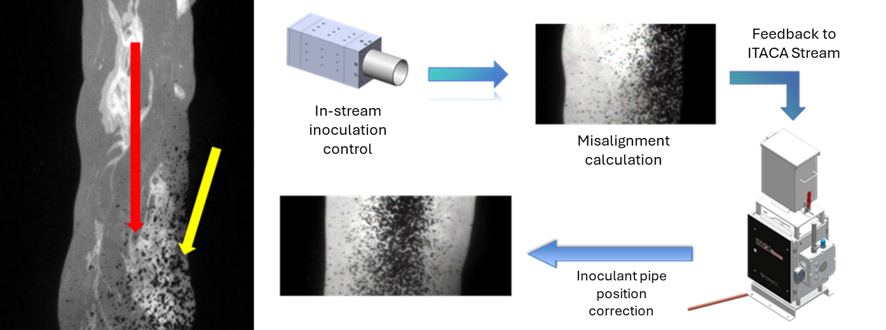
In addition, the system determines the total amount of inoculant delivered and the fraction effectively incorporated into the molten iron, ensuring full traceability of in-stream inoculation.
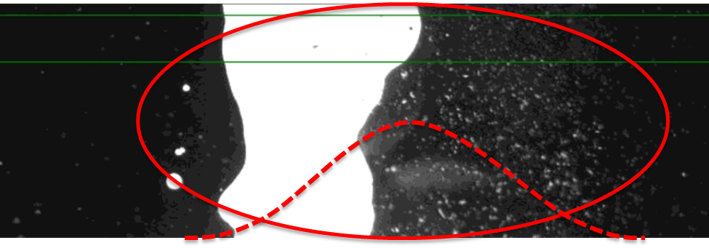
Monitoring activities carried out by Proservice have revealed critical issues that are far more frequent than foundries typically assume, including:
- non-constant inoculant flow caused by variable iron flow rate and non-uniform inoculant granulometry;
- partial obstructions or blockages in the delivery tube;
- misalignment preventing proper interaction between inoculant and molten metal;
- moulds that are partially or completely not inoculated, often without any alarm being triggered by conventional systems.
The situation becomes even more critical when the foundry does not apply preconditioning or pre-inoculation. In the event of malfunction of the in-stream inoculation, the molten iron enters the mould with low nucleation potential, drastically increasing the risk of metallurgical defects, non-compliant mechanical properties, and production scrap.
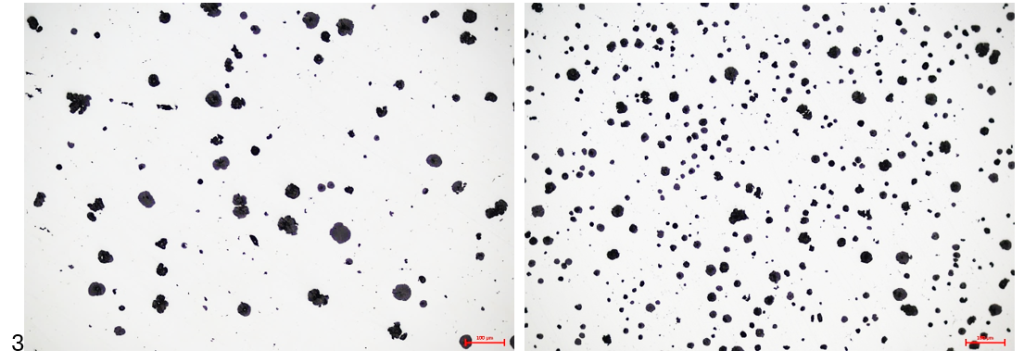
Why do carbides or shrinkage defects appear even when thermal analysis seems perfect?
In foundries, it is widely assumed that the molten iron stream maintains a constant position during pouring. However, operational experience shows the opposite. The stream can shift even within a few minutes due to slag buildup at the pouring sprue, refractory erosion, mechanical tolerances of the moulding line or pouring ladles, as well as wear or deformation of the inoculant delivery pipe.
These variations, often imperceptible to the operator, alter the point of impact of the metal and generate misalignment with respect to the inoculant stream.
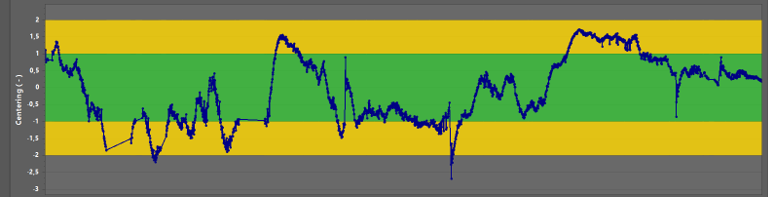
Monitoring through ITACA Vision confirms this behaviour. On a vertical moulding line, the Overlay Ratio parameter dropped within half an hour to values outside the acceptable range, indicating that the inoculant was no longer reaching the molten iron stream, without any alarm from conventional systems.
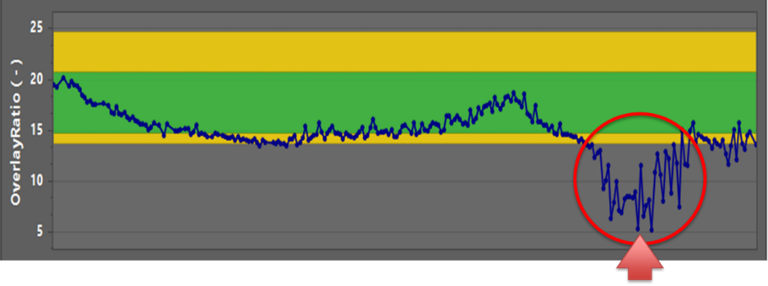
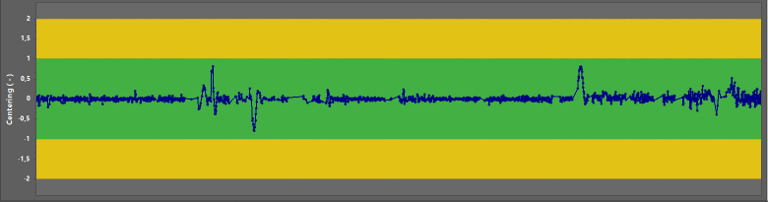
Analysis of the Centering parameter shows that misalignment evolves over time. Only with ITACA Stream does the system automatically restore alignment through controlled movement of the delivery pipe.
These phenomena explain why, even when stable thermal analysis curves are observed (using ITACAX™ software), for example eutectic temperatures of approximately 1145 °C for inoculated iron, carbides or shrinkage defects may still be encountered in production. The thermal analysis cup always receives a known and standardized amount of inoculant, whereas the molten iron in the production line may not be correctly inoculated if in-stream inoculation is not properly monitored.
As a result, the metallurgical quality measured in the analysis cup does not necessarily reflect that of the molten iron entering the mould, creating a false perception of process control. The issue becomes even more critical in foundries that do not apply preconditioning or pre-inoculation. In the presence of in-stream inoculation inefficiencies, the molten iron enters the mould with insufficient nucleation potential, significantly increasing the risk of carbides, shrinkage defects, and defects that appear to be “without cause”.
How much inoculant can be wasted… without the foundry even noticing?
A quantitative assessment shows that, without an advanced control system, inoculant waste during late inoculation (in-stream inoculation) can be very significant. Consider a foundry pouring at 6 kg/s and inoculating at 0.10%, corresponding to 6 g/s. In the absence of monitoring, the dosing rate is typically maintained at this level to compensate for misalignment, flow rate variations, and instability in the pouring system. With consistently well-centered inoculation, the same metallurgical quality could be achieved, for example, with 5 g/s. Quantification of waste
Assuming:
- pouring time per mould: 10 s
- production: 1000 moulds per day
- annual operating days: 300
The following results are obtained:
- waste per mould: 1 g/s × 10 s = 10 g = 0.01 kg
- annual waste: 0.01 kg × 1000 × 300 = 3000 kg/year
With an average inoculant cost of 2.5 €/kg (average value as of March 2026), the associated economic loss is:
3000 kg × 2.5 €/kg = 7500 €/year
This is a conservative estimate. In many foundries, higher productivity, flow fluctuations, misalignment, and variability in granulometry can easily lead to significantly greater waste.
In addition to the economic impact, such waste also results in:
- reduced metallurgical efficiency;
- increased microstructural variability;
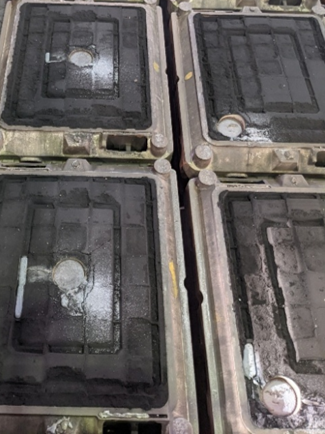
- higher environmental contamination due to inoculant dispersion;
- greater risk of defects, particularly in the absence of preconditioning or pre-inoculation.
Conclusions
The analyses carried out highlight three key points:
- In-stream inoculation is not a guarantee of correct inoculation. It is a stage that is extremely sensitive to misalignment, blockages, flow variations, and anomalies that conventional systems are unable to detect.
- The molten iron stream is not stable over time.Refractory erosion, slag buildup, mechanical tolerances of the moulding line, and movements of the pouring ladles continuously shift the stream, compromising the proper interaction with the inoculant.
- Inoculant waste can be significant. Even a small differential, compensated through overdosing, can result in tons of material being unnecessarily delivered each year, with relevant economic and environmental impacts.
Considering these critical issues, it is evident that in-stream inoculation requires an advanced system for real-time monitoring and correction, capable of eliminating uncontrolled variables and ensuring metallurgical stability from one pour to the next. ITACA Stream and ITACA Vision directly address this need by providing:
- automatic alignment between the molten iron stream and the inoculant stream;
- continuous control of the quantity actually incorporated into the metal;
- full traceability of the entire post-inoculation process.
Only with systems of this type can in-stream inoculation become reliable, efficient, and truly under control.
Introduction
In the first paper of the series, “Critical issues in inoculation practice and main inoculants,” it was shown how inoculation represents one of the most sensitive metallurgical steps in the melting process, influenced by critical variables such as nucleation potential, fading, and addition method.
This second contribution addresses an aspect that is often taken for granted but is, in operational terms, among the most vulnerable: in-stream inoculation. Although commonly perceived as an “automatic” operation, industrial experience demonstrates that it is extremely sensitive to conditions that are difficult to detect without specific monitoring tools.
Partial blockages in the dispensing tube, misalignment between the inoculant stream and the molten iron flow, and unmonitored variations in feed rate can significantly affect the actual amount of inoculant incorporated into the metal. This may lead to dispersion on the sand mould, incomplete or ineffective inoculation, increased metallurgical defects, economic losses, and higher environmental contamination of the sand system.
The objective of this paper is twofold:
- to highlight, from a technical and quantitative standpoint, the intrinsic criticalities of stream inoculation and to explain why it cannot be considered reliable without proper monitoring;
- to show how advanced solutions such as ITACA Stream and ITACA Vision can eliminate these vulnerabilities by ensuring real-time control, dosing accuracy, and traceability of post-inoculation.
If the first paper revealed the metallurgical complexity of inoculation, this second document emphasizes the importance of understanding, and above all controlling, what happens at the most critical moment: the interaction between inoculant and metal during pouring.
Is in-stream inoculation an absolute guarantee of effective inoculation?
In foundries, in-stream inoculation is often regarded as an inherently reliable operation. Once the inoculator is activated, it is generally assumed that the process proceeds correctly throughout the entire pouring cycle. However, Proservice’s experience shows that this assumption is incorrect. In-stream inoculation is in fact one of the most sensitive stages of the melting process and involves operational variability that cannot be detected without dedicated monitoring systems.
To address these critical issues, Proservice has developed ITACA Stream, an inoculator equipped with automatic movement of the inoculant delivery pipe, and ITACA Vision, an advanced camera system that monitors inoculation quality in real time through cyclic dual acquisition at a frequency of two images per second:
- one image is used to evaluate the fraction of inoculant that actually enters the molten iron stream;
- one image is used to measure the fraction dispersed outside the molten iron stream.
These data allow ITACA Vision to calculate the misalignment between the two flows and to provide immediate feedback to ITACA Stream, which automatically adjusts the tube position.
In addition, the system determines the total amount of inoculant delivered and the fraction effectively incorporated into the molten iron, ensuring full traceability of in-stream inoculation.
Monitoring activities carried out by Proservice have revealed critical issues that are far more frequent than foundries typically assume, including:
- non-constant inoculant flow caused by variable iron flow rate and non-uniform inoculant granulometry;
- partial obstructions or blockages in the delivery tube;
- misalignment preventing proper interaction between inoculant and molten metal;
- moulds that are partially or completely not inoculated, often without any alarm being triggered by conventional systems.
The situation becomes even more critical when the foundry does not apply preconditioning or pre-inoculation. In the event of malfunction of the in-stream inoculation, the molten iron enters the mould with low nucleation potential, drastically increasing the risk of metallurgical defects, non-compliant mechanical properties, and production scrap.
Why do carbides or shrinkage defects appear even when thermal analysis seems perfect?
In foundries, it is widely assumed that the molten iron stream maintains a constant position during pouring. However, operational experience shows the opposite. The stream can shift even within a few minutes due to slag buildup at the pouring sprue, refractory erosion, mechanical tolerances of the moulding line or pouring ladles, as well as wear or deformation of the inoculant delivery pipe.
These variations, often imperceptible to the operator, alter the point of impact of the metal and generate misalignment with respect to the inoculant stream.
Monitoring through ITACA Vision confirms this behaviour. On a vertical moulding line, the Overlay Ratio parameter dropped within half an hour to values outside the acceptable range, indicating that the inoculant was no longer reaching the molten iron stream, without any alarm from conventional systems.
Analysis of the Centering parameter shows that misalignment evolves over time. Only with ITACA Stream does the system automatically restore alignment through controlled movement of the delivery pipe.
These phenomena explain why, even when stable thermal analysis curves are observed (using ITACAX™ software), for example eutectic temperatures of approximately 1145 °C for inoculated iron, carbides or shrinkage defects may still be encountered in production. The thermal analysis cup always receives a known and standardized amount of inoculant, whereas the molten iron in the production line may not be correctly inoculated if in-stream inoculation is not properly monitored.
As a result, the metallurgical quality measured in the analysis cup does not necessarily reflect that of the molten iron entering the mould, creating a false perception of process control. The issue becomes even more critical in foundries that do not apply preconditioning or pre-inoculation. In the presence of in-stream inoculation inefficiencies, the molten iron enters the mould with insufficient nucleation potential, significantly increasing the risk of carbides, shrinkage defects, and defects that appear to be “without cause”.
How much inoculant can be wasted… without the foundry even noticing?
A quantitative assessment shows that, without an advanced control system, inoculant waste during late inoculation (in-stream inoculation) can be very significant. Consider a foundry pouring at 6 kg/s and inoculating at 0.10%, corresponding to 6 g/s. In the absence of monitoring, the dosing rate is typically maintained at this level to compensate for misalignment, flow rate variations, and instability in the pouring system. With consistently well-centered inoculation, the same metallurgical quality could be achieved, for example, with 5 g/s. Quantification of waste
Assuming:
- pouring time per mould: 10 s
- production: 1000 moulds per day
- annual operating days: 300
The following results are obtained:
- waste per mould: 1 g/s × 10 s = 10 g = 0.01 kg
- annual waste: 0.01 kg × 1000 × 300 = 3000 kg/year
With an average inoculant cost of 2.5 €/kg (average value as of March 2026), the associated economic loss is:
3000 kg × 2.5 €/kg = 7500 €/year
This is a conservative estimate. In many foundries, higher productivity, flow fluctuations, misalignment, and variability in granulometry can easily lead to significantly greater waste.
In addition to the economic impact, such waste also results in:
- reduced metallurgical efficiency;
- increased microstructural variability;
- higher environmental contamination due to inoculant dispersion;
- greater risk of defects, particularly in the absence of preconditioning or pre-inoculation.
Conclusions
The analyses carried out highlight three key points:
- In-stream inoculation is not a guarantee of correct inoculation. It is a stage that is extremely sensitive to misalignment, blockages, flow variations, and anomalies that conventional systems are unable to detect.
- The molten iron stream is not stable over time.Refractory erosion, slag buildup, mechanical tolerances of the moulding line, and movements of the pouring ladles continuously shift the stream, compromising the proper interaction with the inoculant.
- Inoculant waste can be significant. Even a small differential, compensated through overdosing, can result in tons of material being unnecessarily delivered each year, with relevant economic and environmental impacts.
Considering these critical issues, it is evident that in-stream inoculation requires an advanced system for real-time monitoring and correction, capable of eliminating uncontrolled variables and ensuring metallurgical stability from one pour to the next. ITACA Stream and ITACA Vision directly address this need by providing:
- automatic alignment between the molten iron stream and the inoculant stream;
- continuous control of the quantity actually incorporated into the metal;
- full traceability of the entire post-inoculation process.
Only with systems of this type can in-stream inoculation become reliable, efficient, and truly under control.