Critical issues in inoculation practice and main inoculants

Introduction
Inoculation is one of the most critical, yet often underestimated, stages of the entire cast iron foundry process: microstructure, metallurgical stability, mechanical properties, and the ability of cast iron to avoid defects such as cementite, carbides, or shrinkage all depend on it. Nevertheless, it is still too often performed as a routine operation, without adequate metallurgical control.
This document opens a series of publications dedicated to inoculation, with the aim of clarifying a topic that is both fundamental and complex. In this first paper, we outline the basic principles, the metallurgical mechanisms involved, the available technologies, and the main families of inoculants, evaluating their effectiveness and resistance to fading to support informed technical decisions.
The upcoming chapters in the series will further explore the most common issues related to inoculation and the practical solutions for preventing and managing them effectively.
Why do we need to inoculate cast iron?
Inoculation refers to the addition, shortly before or during pouring, of small amounts (typically 0.05–0.50%) of FeSi alloys enriched with active elements such as Al, Ca, Ba, Sr, Zr, rare earths, or Bi. These elements promote the formation of effective nuclei for heterogeneous graphite nucleation, thereby reducing undercooling and widening the solidification window associated with the stable system (Fe–C → graphite) rather than the metastable one (Fe–C → cementite).
Although silicon is the primary promoter of graphitization, it is not sufficient on its own. Effective nucleation requires elements with high affinity for oxygen and sulphur, capable of forming inclusions suitable for the initiation and growth of graphite.
The purpose of inoculation is to increase eutectic cell count in grey iron and nodule count in ductile iron, reduce white solidification, and improve the mechanical properties and metallurgical quality of the casting. In ductile iron, it is also closely linked to the nodularization treatment, of which it represents an indispensable metallurgical complement.
What is the optimal amount of inoculant?
There is no universally valid inoculant dosage: a fixed amount, while easy to apply, does not guarantee the best metallurgical quality, because the composition of charge materials and corrective additions varies significantly and unpredictably. The required amount depends mainly on the time between inoculation and pouring, the nucleation potential of the base iron, the liquid metal temperature, the materials and technologies used, the type and size of the castings being produced.
To truly optimize additions, advanced process control based on thermal analysis is essential, supported by dedicated software such as ITACAX. Using measured eutectic temperature values and the HEH parameter (a proprietary indicator describing the cast iron’s solidification behaviour), it becomes possible to adjust inoculant additions dynamically, improving both base‑iron and final‑iron quality while avoiding under‑ and over‑inoculation.
What is the fading phenomenon, and how can it be minimized?
Inoculant effectiveness is highest immediately after addition to the liquid metal and decreases over time due to the reabsorption and coarsening of nuclei. Since no inoculant is immune to fading, inoculation becomes more effective the closer it is performed to the pouring stage.
However, relying exclusively on late‑stage inoculation (in‑stream or in‑mould) is risky: it does not ensure optimal metallurgical quality, and any process malfunction may cause metal to enter the mould with insufficient metallurgical characteristics.
For this reason, the best approach is to distribute inoculation throughout the entire process, from melting to pouring. Progressive additions help accompany the metal through each stage, minimizing fading, enhancing metallurgical quality, and reducing risks associated with potential equipment failures.
What is the over‑inoculation phenomenon?
A low nucleation potential, caused by insufficient or ineffective inoculation, leads to undercooling defects such as cementite, carbides, and various shrinkage forms.
Excessive inoculation, however, can also be detrimental: beyond a certain threshold, the number of effective graphite nucleation sites increases excessively, causing graphite growth to be distributed over too many sites and resulting in smaller graphite nodules or flakes, thereby altering the normal solidification process. Under these conditions, the balance between solidification shrinkage and graphite expansion may also be affected and, once the feeders are no longer able to supply liquid metal to the casting, compensation for secondary shrinkage may become less effective, promoting the formation of shrinkage porosity. For this reason, inoculation should be applied in multiple stages and dynamically controlled, particularly through preconditioning and pre-inoculation, supported by careful thermal analysis (e.g., ITACAX).
In this sense, inoculant behaves like a medicine: too little is ineffective, too much becomes harmful.
What are the current inoculation practices?
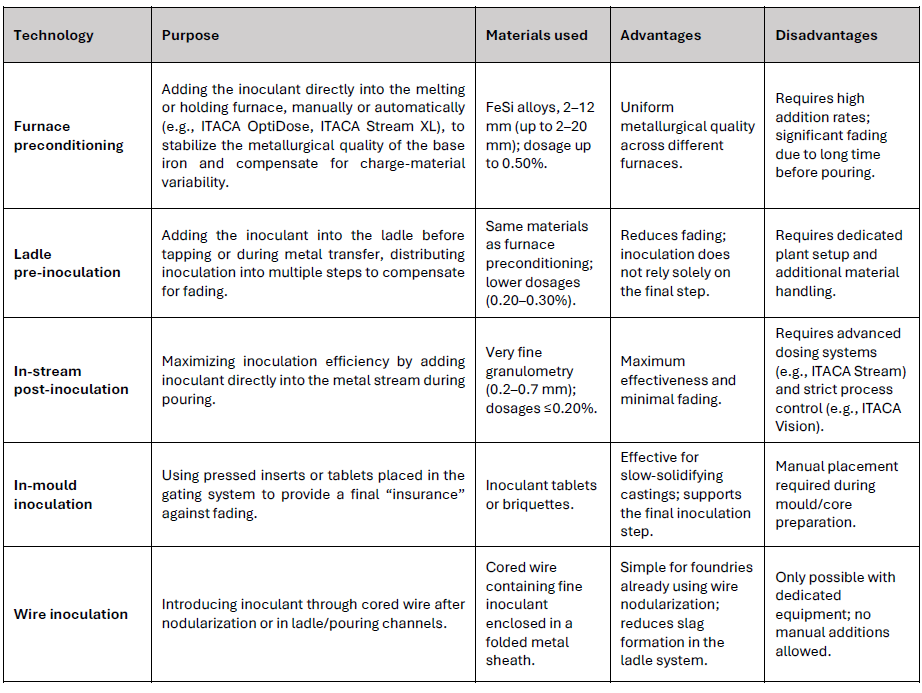
Today, many inoculation methods and a wide variety of products and materials are available to meet different process needs. The most common practices can be summarised as follows:
Which classes of inoculants offer the highest effectiveness in grey and ductile iron?
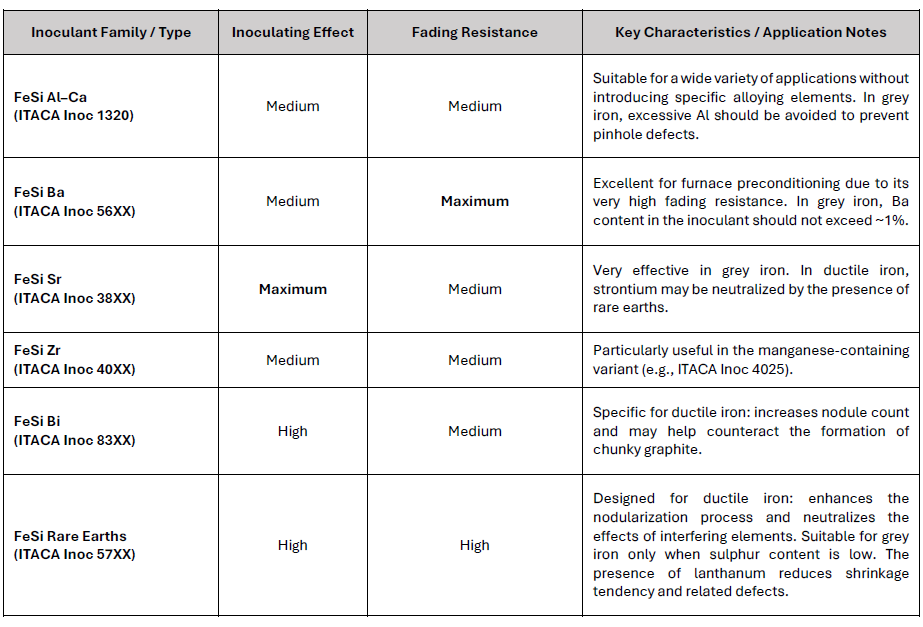
The main classes of inoculants are FeSi‑based alloys containing active elements (Al, Ca, Ba, Sr, Zr, rare earths, Bi), which play a fundamental role in increasing the nucleation potential of cast iron and reducing fading. Most of them can be used in both grey and ductile iron, although some formulations perform better in one than in the other. In ductile iron, the required additions are generally higher because magnesium, being strongly carbide‑forming, reduces the metal’s ability to nucleate graphite and must therefore be compensated. Below is an overview of the main inoculants, using standard FeSi, characterized by low nucleation potency and low fading resistance, as a reference baseline.
Conclusions
This work has examined the fundamental principles of inoculation and the main factors that determine its effectiveness, from nucleation potential to the fading phenomenon. Practical guidelines have been provided on how to correctly plan inoculation by distributing it across multiple stages of the process to minimize fading and avoid both under‑ and over‑inoculation.
A comprehensive overview of the technologies currently available has also been presented, from furnace preconditioning to pre‑ and post‑inoculation methods, and wire inoculation, together with a review of the main inoculant families and their application characteristics.
Since inoculation is a highly sensitive and strategically important step, the choice of method, material, and dosage must be carefully tailored to the metallurgical and production requirements of the foundry. For companies wishing to optimize their practices or explore specific aspects in greater depth, ProService provides expert metallurgical support, offering qualified technical consultancy and operational assistance to ensure maximum process control and the highest cast‑iron quality.
Introduction
Inoculation is one of the most critical, yet often underestimated, stages of the entire cast iron foundry process: microstructure, metallurgical stability, mechanical properties, and the ability of cast iron to avoid defects such as cementite, carbides, or shrinkage all depend on it. Nevertheless, it is still too often performed as a routine operation, without adequate metallurgical control.
This document opens a series of publications dedicated to inoculation, with the aim of clarifying a topic that is both fundamental and complex. In this first paper, we outline the basic principles, the metallurgical mechanisms involved, the available technologies, and the main families of inoculants, evaluating their effectiveness and resistance to fading to support informed technical decisions.
The upcoming chapters in the series will further explore the most common issues related to inoculation and the practical solutions for preventing and managing them effectively.
Why do we need to inoculate cast iron?
Inoculation refers to the addition, shortly before or during pouring, of small amounts (typically 0.05–0.50%) of FeSi alloys enriched with active elements such as Al, Ca, Ba, Sr, Zr, rare earths, or Bi. These elements promote the formation of effective nuclei for heterogeneous graphite nucleation, thereby reducing undercooling and widening the solidification window associated with the stable system (Fe–C → graphite) rather than the metastable one (Fe–C → cementite).
Although silicon is the primary promoter of graphitization, it is not sufficient on its own. Effective nucleation requires elements with high affinity for oxygen and sulphur, capable of forming inclusions suitable for the initiation and growth of graphite.
The purpose of inoculation is to increase eutectic cell count in grey iron and nodule count in ductile iron, reduce white solidification, and improve the mechanical properties and metallurgical quality of the casting. In ductile iron, it is also closely linked to the nodularization treatment, of which it represents an indispensable metallurgical complement.
What is the optimal amount of inoculant?
There is no universally valid inoculant dosage: a fixed amount, while easy to apply, does not guarantee the best metallurgical quality, because the composition of charge materials and corrective additions varies significantly and unpredictably. The required amount depends mainly on the time between inoculation and pouring, the nucleation potential of the base iron, the liquid metal temperature, the materials and technologies used, the type and size of the castings being produced.
To truly optimize additions, advanced process control based on thermal analysis is essential, supported by dedicated software such as ITACAX. Using measured eutectic temperature values and the HEH parameter (a proprietary indicator describing the cast iron’s solidification behaviour), it becomes possible to adjust inoculant additions dynamically, improving both base‑iron and final‑iron quality while avoiding under‑ and over‑inoculation.
What is the fading phenomenon, and how can it be minimized?
Inoculant effectiveness is highest immediately after addition to the liquid metal and decreases over time due to the reabsorption and coarsening of nuclei. Since no inoculant is immune to fading, inoculation becomes more effective the closer it is performed to the pouring stage.
However, relying exclusively on late‑stage inoculation (in‑stream or in‑mould) is risky: it does not ensure optimal metallurgical quality, and any process malfunction may cause metal to enter the mould with insufficient metallurgical characteristics.
For this reason, the best approach is to distribute inoculation throughout the entire process, from melting to pouring. Progressive additions help accompany the metal through each stage, minimizing fading, enhancing metallurgical quality, and reducing risks associated with potential equipment failures.
What is the over‑inoculation phenomenon?
A low nucleation potential, caused by insufficient or ineffective inoculation, leads to undercooling defects such as cementite, carbides, and various shrinkage forms.
Excessive inoculation, however, can also be detrimental: beyond a certain threshold, the number of effective graphite nucleation sites increases excessively, causing graphite growth to be distributed over too many sites and resulting in smaller graphite nodules or flakes, thereby altering the normal solidification process. Under these conditions, the balance between solidification shrinkage and graphite expansion may also be affected and, once the feeders are no longer able to supply liquid metal to the casting, compensation for secondary shrinkage may become less effective, promoting the formation of shrinkage porosity. For this reason, inoculation should be applied in multiple stages and dynamically controlled, particularly through preconditioning and pre-inoculation, supported by careful thermal analysis (e.g., ITACAX).
In this sense, inoculant behaves like a medicine: too little is ineffective, too much becomes harmful.
What are the current inoculation practices?
Today, many inoculation methods and a wide variety of products and materials are available to meet different process needs. The most common practices can be summarised as follows:
Which classes of inoculants offer the highest effectiveness in grey and ductile iron?
The main classes of inoculants are FeSi‑based alloys containing active elements (Al, Ca, Ba, Sr, Zr, rare earths, Bi), which play a fundamental role in increasing the nucleation potential of cast iron and reducing fading. Most of them can be used in both grey and ductile iron, although some formulations perform better in one than in the other. In ductile iron, the required additions are generally higher because magnesium, being strongly carbide‑forming, reduces the metal’s ability to nucleate graphite and must therefore be compensated. Below is an overview of the main inoculants, using standard FeSi, characterized by low nucleation potency and low fading resistance, as a reference baseline.
Conclusions
This work has examined the fundamental principles of inoculation and the main factors that determine its effectiveness, from nucleation potential to the fading phenomenon. Practical guidelines have been provided on how to correctly plan inoculation by distributing it across multiple stages of the process to minimize fading and avoid both under‑ and over‑inoculation.
A comprehensive overview of the technologies currently available has also been presented, from furnace preconditioning to pre‑ and post‑inoculation methods, and wire inoculation, together with a review of the main inoculant families and their application characteristics.
Since inoculation is a highly sensitive and strategically important step, the choice of method, material, and dosage must be carefully tailored to the metallurgical and production requirements of the foundry. For companies wishing to optimize their practices or explore specific aspects in greater depth, ProService provides expert metallurgical support, offering qualified technical consultancy and operational assistance to ensure maximum process control and the highest cast‑iron quality.